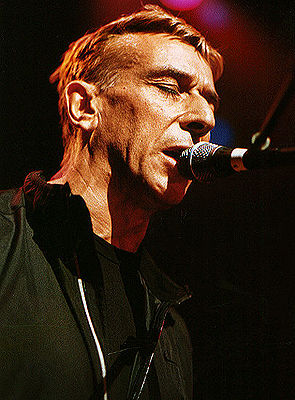
John Cale was born in Garnant, West Glamorgan, Wales in 1942. A student of viola and keyboards at Goldsmith's college, he was awarded the Leonard Berstein scholarship for Modern composition in the Eastman Conservatory at Tanglewood in Massachusetts. He left fairly swiftly, and moved to New York, where he joined the Dream Syndicate, an avant garde ensemble, started by LaMonte Young.
It was during this period that Cale discovered and started playing rock and roll, and after meeting Lou Reed, they formed the group that evolved into the Velvet Underground. However, the myths surrounding their relationships are plenty, the most popular rumour being that both Lou and John had a relationship with Nico. Whatever the reasons, Cale was ejected/left the band in 1968, shortly after the "White Light White Heat" album.
After leaving the Velvets, Cale went on to produce a record for Nico and worked with The Stooges, before embarking on his own solo career. His production of Patti Smith's seminal "Horses" album in 1975 led to a renewed interest in his work by a punk rock audience. In 1990 Cale and Lou Reed worked together once more, on the "Songs for Drella" album, which was a tribute to Andy Warhol, an album that was well received by both critics and audiences. This album led to rumours of a Velvet Underground reunion, which proved to be founded when the original line up toured briefly in 1993. This proved to be short lived, and legend has it that Reed sacked the band entire band by fax...
Cale is an unlikely rock figure. Looking at his academic and cultural background, it would be safe to assume that a career in classical music was more likely to be his fate. However, Cale is nothing if not a man of contradictions, he's been a punk rock hero, a bandleader, and a rock and roll genius, he's written symphonic masterpieces, minimalistic works, tender ballads and full blown rants.
Cale is still creating highly respected solo albums, and has also branched out into soundtrack works, including the musical scores for "I Shot Andy Warhol" in 1995, and Basquiat in 1996.