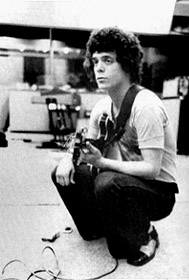
"If God showed up tomorrow and said Do you want to be President? No. Do you want to be in politics? No. Do you want to be a lawyer? No. What do you want? I want to be a rhythm guitar player."
Louis Allen Reed was born in Brooklyn, New York on March 2nd, 1942. By the age of fifteen, his musical aspirations were already well in place, he was inspired by early rock n roll he heard on his AM stereo, ("then one fine morning she put on that New York station, she couldn't believe what she heard at all, she started dancing to that fine fine music, you know her life was saved by rock n roll..."). His group, The Jades released a single, "Leave Her For Me", and his first royalty cheque came to the grand sum of seventy cents.
Lou studied english at Syracuse University, after briefly studying at NYU. There he became close to Delmore Shwartz, the poet, and it was also there that he met Sterling Morrison. Before graduation, he had already written "Heroin", and "The Gift", the later being adapted from one of his essays.
Reed became an assembly line songwriter for Pickwick Records in Long Island city after he graduated, where he wrote classics such as "The Ostrich", "Cycle Annie" and "Sneaky Pete", which can all now be found, fairly easily, on Napster.
The Velvets started to take shape after Lou met John Cale, a classically trained multi-instrumentalist, and they shared an apartment on the Lower East Side of New York City. After a chance meeting with Sterling on a subway train, the three began to rehearse mostly acoustic songs together. Moe Tucker, whose brother was friends with Sterling, joined the band shortly after, and this line up of the VU played their first gig at New Jersey high school.
After the V.U. fell to pieces, Lou made his way back to New York City. At this point, David Bowie was in the midst of his massive Ziggy Stardust tour, where "White Light White Heat" and "Waiting for the Man" are regular parts of his set list. It was during this time that Bowie started name dropping Lou and the Velvets as a heavy influence on his music...
Meanwhile, Lou met Richard and Lisa Robinson, who were consummate V.U. fans, and they help him to get a solo recording contract with RCA. Lou joined Bowie onstage for a rendition of "White Light White Heat" in London, and finished his first solo album, surprisingly called "Lou Reed". The album featured versions of previously lost Velvets tracks, and Lou employed Caleb Quaye and Rick Wakeman to work on the album.
In 1973 Lou released the "Transformer" album, which included the simply beautiful classic "Satellite of Love", and one of his most successful hits, "Walk on the Wild Side". Produced by Mick Ronson, and pretty much promoted by Bowie, "Transformer" became Reed's big hit, and was quickly followed up with the brilliant "Berlin". "Berlin" wasn't a commercial success however, although it is simply the most beautiful, sombre album.
More success followed with the release of "Rock N Roll Animal", which included new versions of "Sweet Jane", "Rock and Roll" and "Heroin". This attracted a whole new audience, both for Lou Reed and for the Velvets older works, and "Rock N Roll Animal" sold in the hundred thousands... from here on Lou's career became what can only be termed as hugely successful.
The fourteenth album, "New York" is considered by many to be his masterpiece. A simple guitar/bass/drums combination, it contained the narratives that Lou is famed for, the characters that he built were so vivid and alive. "New York", containing such gems as "Dirty Boulevard" and "Romeo and Juliette" went gold, and "Busload of Faith" was used in a James Woods film, True Believers.
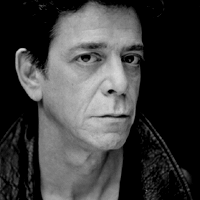
And so to present times. Lou's last album, "Ecstasy" was a return in a sense to past glorys, and was widely toured. I was lucky enough to catch a concert at the Royal Albert Hall, where all the tracks from the album were played, along with a few V.U. favourites, such as "Sweet Jane" (at which point I burst into tears, yes yes, I am sad), "Dirty Boulevard" and the obligatory "Perfect Day". Since the "Trainspotting" films used "Perfect Day", that track has become more associated with Lou Reed perhaps than any other, more so than even "Walk On The Wild Side", although I do truly hate the BBC version with various singers taking on a line each... I think the song lost it's honesty when that track was recorded. Perhaps that's just me, I tend to like things raw, a quality that Lou Reed has always held.
"My God is rock’n’roll. It’s an obscure power that can change your life. The most important part of my religion is to play guitar."